How Does a Cantilever Gate Work?
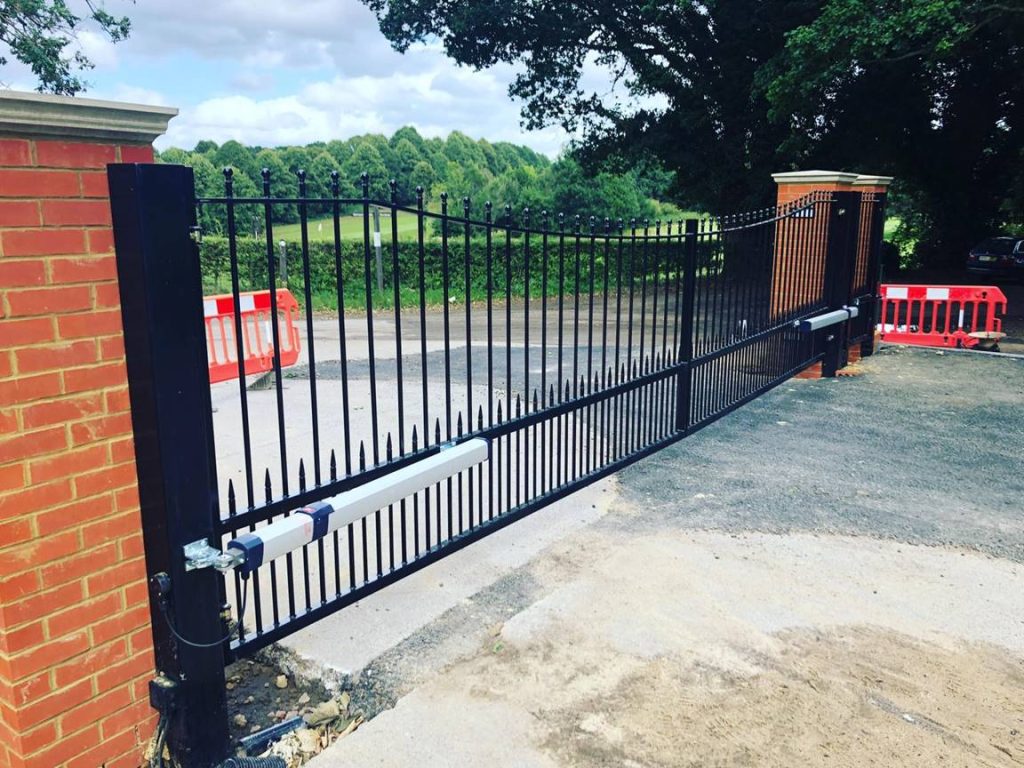
A cantilever gate works by sliding open or closed. It rides on rollers on posts at the opening. No part of the gate touches the ground, and it doesn’t slide along a track to move like many other sliding gates. It carries its own weight from one side of the opening and is longer than the space it covers.
In this blog, we’ll explore how cantilever gates work, the differences between them and other sliding gates, their advantages, disadvantages and what to consider when planning to add one to your home or business.
What is a cantilever gate?
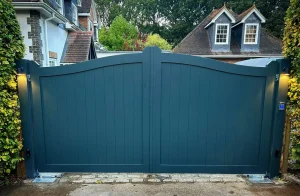
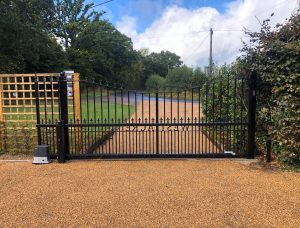
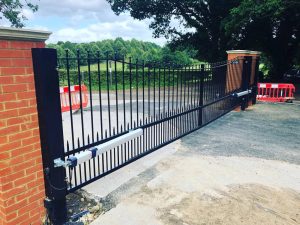
A cantilever gate is a type of sliding gate that opens and closes without needing a ground track for it to slide along. The gate uses a cantilevered structure that is supported by rollers mounted to a side post.
With the assistance of guide rollers, it moves parallel to the wall without touching the ground.
They can take up some considerable space, as the gate leaf is considerably larger than the area it fills. This is because the gate requires a counterbalance section. You’ll often see this referred to as the tail section. This means that the gate, when sliding open, fills much more space than a sliding gate on a track. As a rule of thumb, you’ll need an opening space that covers around one and a half times the opening width.
Because it sits clear of the ground, it appears almost as if it is floating.
How a cantilever gate works: Step by step
A cantilever gate carries its entire weight from one side of the opening, using a counterbalanced structure that rolls on fixed supports rather than along the ground.
The gate leaf has a steel beam or channel built into its base that runs along the full length of the gate.
This beam sits on two sets of roller carriages that are bolted to concrete foundations beside the opening.
It works oppositely to a tracked sliding gate. Where a tracked gate has wheels fixed to the gate that run along a track set into the ground, the cantilever gate's carriages stay still, and the gate rolls over them.
The section of the gate that covers the opening is balanced by the “tail”. This is the length of the gate that goes beyond the support posts. It’s this “tail” that keeps the leaf level and stable as it moves. This means the gate never needs any support on the other side as it moves.
At the top of the support posts, a set of guide rollers keeps the gate upright and stops it swaying as it slides. To prevent the gate overrunning the carriages, end stops are in place with a catch post at the closing edge supporting the lead end once the gate closes.
What is the difference between a cantilever gate, a swing gate and a tracked sliding gate?
Whilst all gates fundamentally do the same thing, how they operate means they are suited to different environments. Our table below outlines the key differences that you’ll need to consider when adding a gate to your home or business.
| Cantilever gate | Swing gate | Tracked sliding gate | |
| How it opens | Slides sideways, carried on fixed roller carriages | Swings backwards or forwards, like a door | Slides sideways on wheels along a ground track |
| Ground track? | No | No | Yes, runs full width of opening |
| Space needed | Clear run-back beside the opening to cover gate AND tail | Clear arc in front of or behind the gate for it to swing open or shut | Clear run-back beside the opening for the gate |
| Suitable for sloped/uneven ground? | Yes | Limited | Needs level ground for the track |
| Maintenance | Lower due to fewer ground-level parts that may get blocked or damaged | Low, but hinges and posts may wear due to heavy use | Tracks may need frequent clearing |
| Manual or automatic? | Both | Both | Both |
| Best for? | High traffic areas, sloped surfaces, properties wanting enhanced security | Properties with space in front or behind for smooth opening/closing | Level sites with suitable side space and a surface that can be easy to clean |
What are the advantages of a cantilever gate?
Cantilever gates can be a great addition to a house or business. Below, we’ve listed some of the most common reasons people may choose one over other gate types:
- Do not require space in front or behind
- No track to run means no blockages stopping its movement
- Available as manual or automatic
- Work well on sloped or uneven ground
- Robust security
- Lower maintenance than a tracked gate
What are the disadvantages of cantilever gates?
Cantilever gates also pose some challenges, meaning they aren’t always suitable for your property. These include:
- Large space to the side of the gate required (approx. one and a half times the gate's opening)
- Potentially more expensive due to the extra materials required for the tail
- More complex installation
- Not suitable for premises with tight space restrictions at the sides
- Need stronger support posts and deeper foundations than other gates as the posts carry the whole gate
- Long leaves must be well braced to avoid sagging over time
Where is a cantilever gate best suited?
Cantilever gates are suitable for many properties as a robust security measure or a durable entrance and exit point. Because of how they operate, they suit premises with a sloped entrance. Because of their size, they are often preferred in areas with high traffic levels or security demands. You’ll often find cantilever gates used in:
- Residential properties with a sloped driveway
- Schools
- Business parks
- Industrial sites
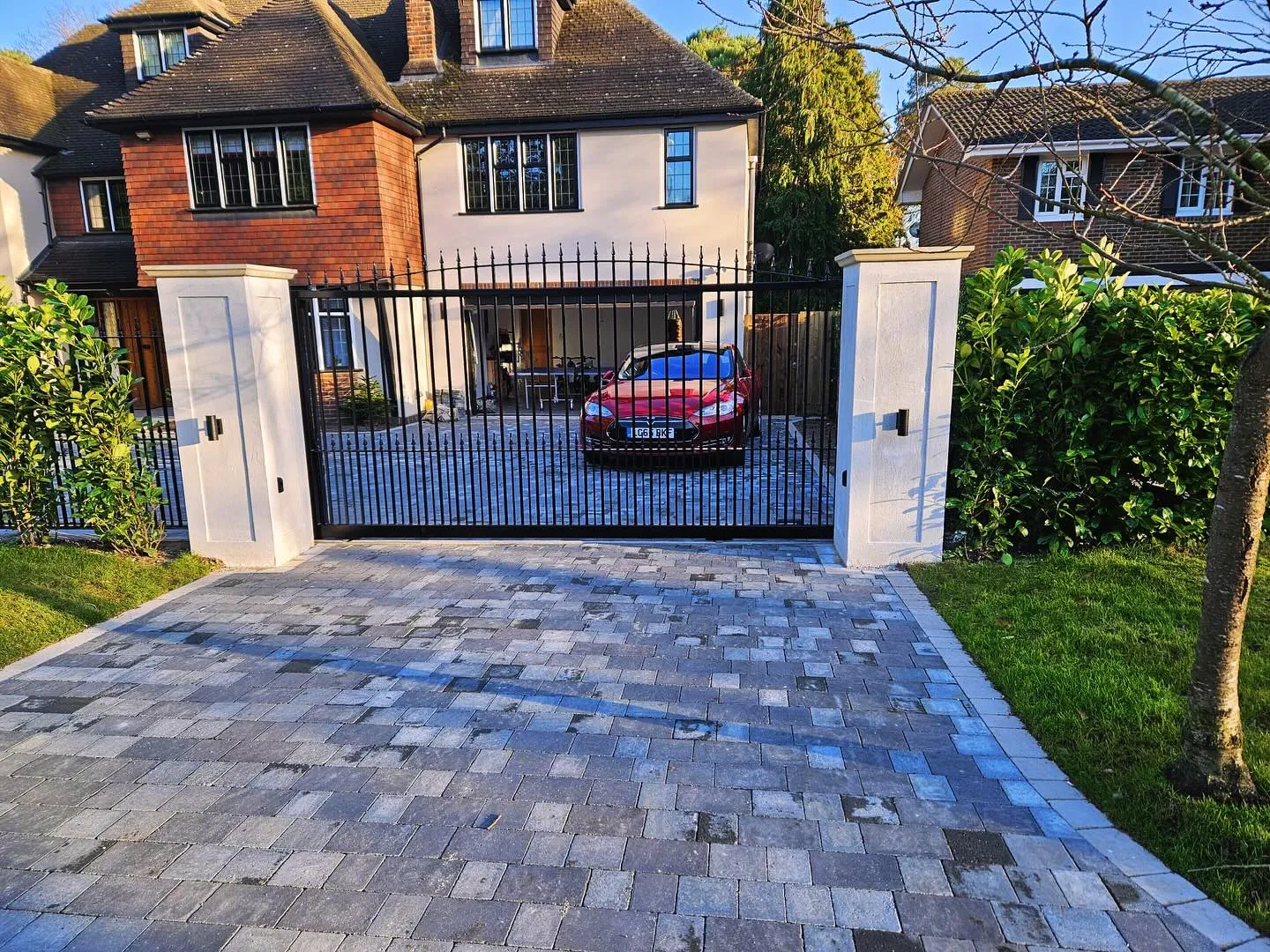
Cantilever gates can add an improved aesthetic as well; their graceful sliding and variety of finishes mean a business or school, for example, can enhance its kerb appeal considerably.
However, before settling on a cantilever gate, you’ll need to ensure there is enough space for it to open fully.
Do cantilever gates need a lot of maintenance?
Compared to some other gates, cantilever gates need less maintenance. Without a track to run along, you avoid the common issue of a clogged or damaged track.
You’ll need to ensure regular servicing, and it may be best to have a professional assessment every six months to check that the gate works properly and safely.
Do cantilever gates have to meet certain safety standards?
Yes. Any automated gate used in a workplace or in a public-facing area is considered machinery. This means that it falls within the Supply of Machinery (Safety) Regulations 2008.
The risks of injury and even death are real, so gates must be designed, installed and maintained with these regulations in mind.
Whilst a duty lies with the manufacturer, there is also a responsibility of those who purchase the gate to ensure it is kept in safe working order.
Current British standards that apply to cantilever gates include:
- BS EN 13241: The product standard that covers the construction and performance of industrial, commercial and garage doors and gates. It includes durability, wind resistance and mechanical strength.
- BS EN 12453: The operational safety standard that specifies the safety requirements for power-operated gates, such as protecting people from crushing, impact and other hazards. It now also contains the force test methods previously in BS EN 12445.
For sites where the risk may be classified as high, such as government buildings, additional safety measures are often required.
- LPS 1175 is a forced-entry resistance test that grades how long a gate can resist an attempted forced entry with tools. This can be expensive, but equally worthwhile.
- ISO 22343-1 is the vehicle-impact test standard for vehicle security barriers, measuring how well a gate withstands a vehicle driven at speed. This replaces PAS 68 and IWA 14 standards.
Can cantilever gates be manual or automatic?
Cantilever gates can be manual or automatic, and both options come with benefits and drawbacks.
- Manual cantilever gates: These can be best for premises where the gate may not be subjected to heavy use, or power may not be easily available. The gate requires someone to open and close it, and whilst the cantilever system makes this easy, if traffic is constantly flowing in and out, and you need to verify identities before granting access, it can create delays.
- Automated cantilever gates: An automatic gate is perhaps the best option if it is in constant use. Various access control systems can also be added, making it easy for people to enter and exit while keeping you in control of who has access to your property.
Key considerations before choosing a cantilever gate
Before choosing a cantilever gate for your home or business, you’ll need to weigh up whether it is the most suitable option. Think about:
- Space: Do you have enough space for the gate and the tail? (roughly 1.5x the opening)
- Ground conditions: Is the soil firm enough for the foundations, and is the site sloped or uneven?
- Usage: Is this a heavy traffic area? If so, you may benefit from an automated system.
- Security: Do you need to consider ISO 22343-1?
- Safety and standards: If automated, the gate must meet the required BS standards.
- Budget: Design, installation, foundations, servicing, automation and more.
Considering cantilever gates?
If you think cantilever gates can enhance security and kerb appeal, speak to our team at Harrier Gates. We design, build and install gates tailored to your property. From manual or automatic installations to access control systems and bespoke designs, our team creates cantilever gates that suit your property and its requirements. We cover West Sussex, Surrey, Hampshire and more, providing proven expertise to home and business owners. Gate Safe accredited and members of SafeContractor, we are a trusted name. We also provide a 12-month guarantee on new installations. Contact us today to explore your options.